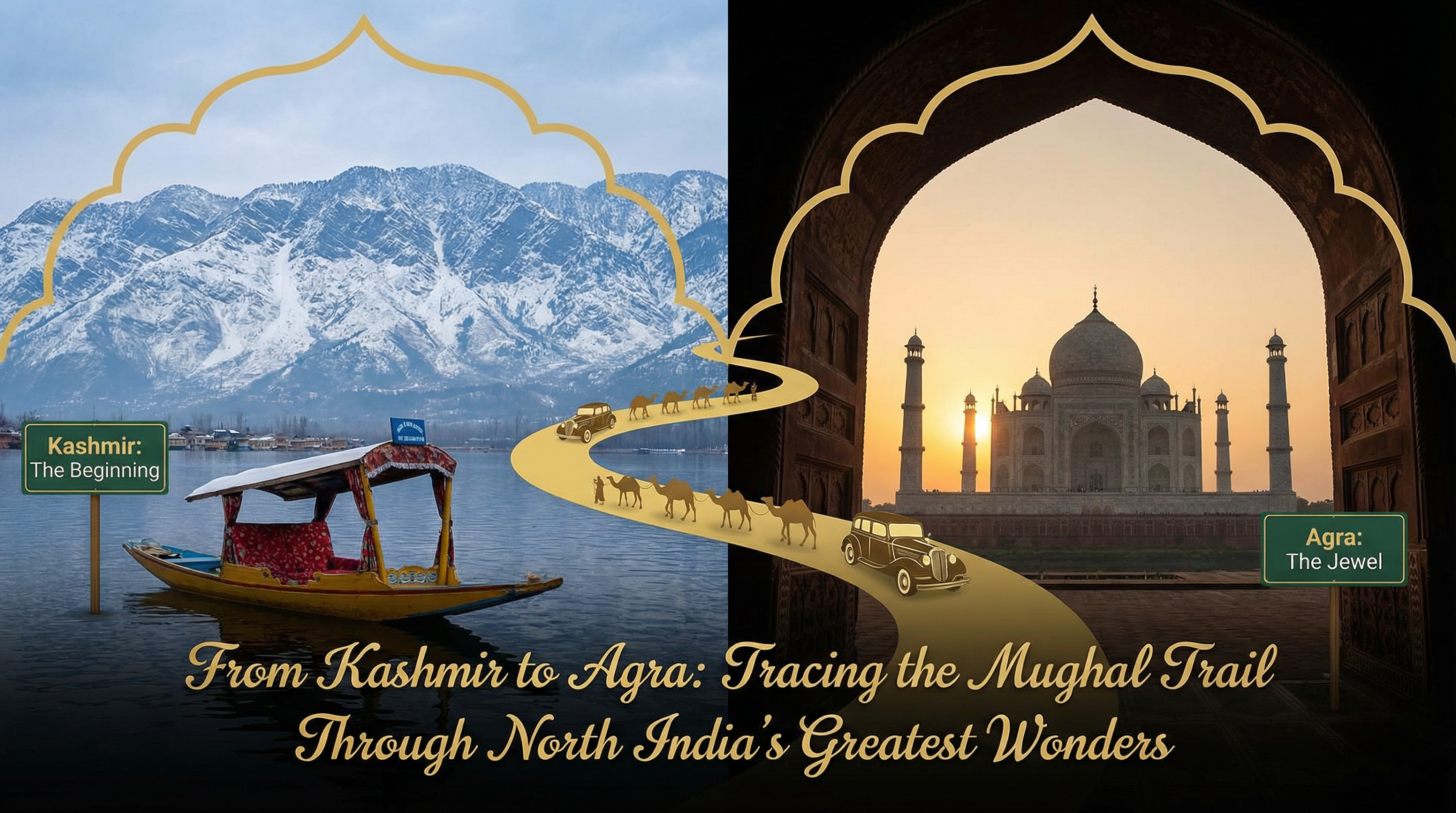
The Mughals didn’t just build an empire — they crafted a legacy in marble, water, and gardens that stretches from the snow-kissed valleys of Kashmir to the sun-bathed plains of Agra. If you’ve ever dreamed of walking in the footsteps of emperors, this is the journey that connects two of India’s most soul-stirring destinations into one grand adventure.
At KashmirTickets.com, we’ve spent years helping travellers discover the magic of Kashmir — from the mirror-still waters of Dal Lake to the flower-carpeted meadows of Gulmarg. But there’s a question our guests keep asking: “What else should we see in North India?”
The answer, almost always, is Agra. And it’s not just about the Taj Mahal (though that alone is worth the trip). It’s about understanding a shared heritage — one that begins in Kashmir’s Mughal Gardens and culminates in Agra’s architectural masterpieces. This blog is your guide to experiencing both, and understanding why these two destinations are forever intertwined.
The Mughal Thread That Binds Kashmir & Agra

Emperor Jahangir famously said about Kashmir: “If there is paradise on earth, it is this, it is this, it is this.” So enchanted were the Mughals by Kashmir’s beauty that they built elaborate terraced gardens — Shalimar Bagh, Nishat Bagh, and Chashme Shahi — that still bloom along the edges of Dal Lake today.
But the same dynasty that fell in love with Kashmir’s valleys also poured their hearts into the plains of Agra. Shah Jahan, Jahangir’s son, commissioned the Taj Mahal as an eternal monument to love. The Agra Fort, Itimad-ud-Daulah (the “Baby Taj”), and the hauntingly beautiful Mehtab Bagh all echo the same artistic vocabulary you see in Kashmir’s gardens — geometric symmetry, flowing water channels, and a reverence for nature’s beauty framed in stone.
Travelling from Kashmir to Agra isn’t just a change of scenery — it’s following the same artistic soul across two very different landscapes. One is carved in living green and reflected in water; the other is sculpted in white marble and red sandstone. Together, they tell the complete story of Mughal genius.
“To visit Kashmir without seeing Agra — or Agra without having breathed the air of Kashmir — is to read only half of the Mughal love letter to India.”
Part One: Kashmir — Where Your Journey Begins
Every great journey needs a great beginning, and there’s no finer starting point than the Kashmir Valley. Whether you arrive in Srinagar by flight (into Sheikh ul-Alam International Airport) or by road through the dramatic Jawahar Tunnel, the first glimpse of the valley is guaranteed to steal your breath.
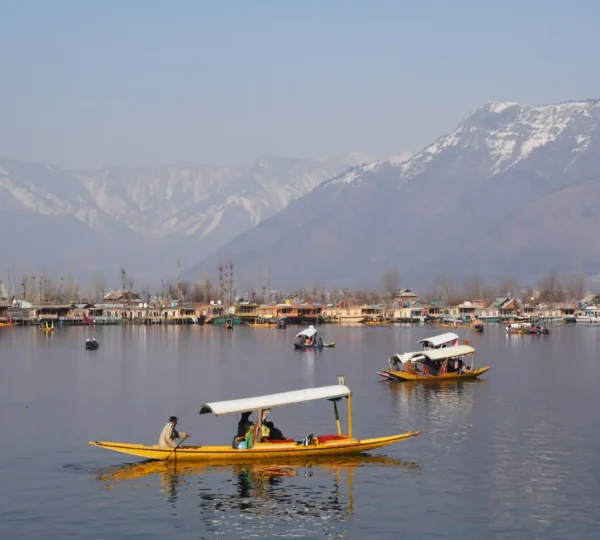
🛶 Shikara ride on Dal Lake
🌸 Must-Experience Moments in Kashmir
A night on a houseboat: The iconic houseboats of Dal Lake aren’t just accommodation — they’re a cultural institution. Hand-carved walnut wood interiors, embroidered curtains, and the gentle lap of water against the hull as you drift to sleep. This is Kashmir at its most intimate.
The Mughal Gardens at golden hour: Visit Nishat Bagh or Shalimar Bagh in the late afternoon, when the Zabarwan mountains behind them turn amber and the terraced fountains catch the last light. You’ll understand exactly why the Mughals spent fortunes creating these spaces.
A day in Gulmarg: In winter, it’s Asia’s premier skiing destination. In summer, it’s a wildflower meadow framed by Himalayan peaks. The Gulmarg Gondola — one of the world’s highest cable cars — lifts you to 13,780 feet, where the views stretch across the Line of Control into distant mountain ranges.
Pahalgam & Betaab Valley: Follow the Lidder River through pine forests to Pahalgam, the “Valley of Shepherds.” Nearby Betaab Valley (named after a Bollywood film) is a carpet of green so vivid it looks digitally enhanced — but it’s gloriously, impossibly real.
💡 KashmirTickets Pro Tip
Book your Kashmir experience through KashmirTickets.com before extending your trip to Agra. We offer curated packages that include houseboat stays, Gulmarg day trips, and guided Mughal Garden walks — the perfect foundation before you continue south to explore the Taj.
The Journey South: Kashmir to Agra

Getting from Kashmir to Agra is easier than most travellers think. The most practical route is a flight from Srinagar to Delhi (approximately 1.5 hours), followed by one of several options to reach Agra:
| Route Option | Duration | Best For |
|---|---|---|
| 🚄 Gatimaan Express (Delhi → Agra) | 1 hr 40 min | Speed & comfort |
| 🚗 Private car via Yamuna Expressway | 3–4 hours | Flexibility & stops |
| 🚌 Luxury bus service | 4–5 hours | Budget travellers |
| ✈️ Srinagar → Agra (via Delhi connection) | 4–5 hours total | Time-saving |
We recommend spending 3–5 days in Kashmir before making the journey south. This gives you enough time to soak in the valley’s beauty without rushing, and you’ll arrive in Agra refreshed and ready for an entirely different — but equally magnificent — chapter of your North India story.
Part Two: Agra — The Mughal Empire’s Crown Jewel
If Kashmir was the Mughals’ summer paradise, Agra was their power centre — the beating heart of an empire that once controlled most of the Indian subcontinent. And while the Taj Mahal is the headline act, Agra has far more to offer than most visitors realize.
The best way to truly experience Agra isn’t through a rushed day trip — it’s by immersing yourself in the city with knowledgeable guides who can reveal the stories, secrets, and hidden corners that most tourists never see. That’s exactly what local tours in Agra offer: authentic, ground-level experiences led by people who know every marble inlay, every sunset viewpoint, and every legendary street food stall in the city.

🕌 The Taj Mahal: Beyond the Photograph
You’ve seen it a thousand times in photographs, but nothing — absolutely nothing — prepares you for seeing the Taj Mahal in person. The way the white Makrana marble shifts colour through the day — pinkish at dawn, blazing white at noon, golden at sunset, and silvery under moonlight — is something a camera simply cannot capture.
What most visitors miss is the incredible detail. The semi-precious stone inlays (pietra dura) in the walls feature jasper from Punjab, jade from China, turquoise from Tibet, lapis lazuli from Afghanistan, and sapphire from Sri Lanka. Each flower motif contains up to 60 individual stone pieces. It took 22 years and 20,000 artisans to complete.
Insider tip: Visit at sunrise. The crowds are thinner, the light is magical, and the reflection in the long pool is at its most perfect. A good local guide will position you at exactly the right spot at exactly the right moment.
🏰 Agra Fort: The Prison with a View
This massive red sandstone fortress served as the main residence of Mughal emperors until 1638. Its most poignant story? After Shah Jahan was deposed by his own son Aurangzeb, he was imprisoned inside the fort’s Musamman Burj — an octagonal tower with a direct view of the Taj Mahal. He spent his final eight years gazing at the monument he’d built for his wife, visible but forever unreachable.
Coming from Kashmir, where you’ve just walked through Jahangir’s pleasure gardens, standing in the same fort where his son lived and died adds an emotional depth that transforms this from tourism into something genuinely moving.
🌿 Mehtab Bagh: The Forgotten Garden
Across the Yamuna River from the Taj, the Mehtab Bagh (Moonlight Garden) offers what many consider the finest view of the monument. Originally built by Emperor Babur, it was designed as a mirror-image complement to the Taj Mahal’s gardens. At sunset, when the marble glows amber-gold against a darkening sky, this is the most romantic viewpoint in all of India.

🍛 Agra’s Street Food: The Unsung Hero
After the refined flavours of Kashmiri wazwan cuisine — the slow-cooked rogan josh, the aromatic gushtaba, the saffron-infused modur pulao — Agra’s street food hits different. And gloriously so.
Petha, a translucent sweet made from ash gourd, is Agra’s signature confection — available in everything from classic to chocolate-coated varieties. Bedai with jalebi is the local breakfast of champions: crispy deep-fried bread served with spicy potato curry and syrup-soaked spirals of sweet batter. And chaat at Sadar Bazaar is an explosion of tangy, spicy, crunchy, sweet flavours that is pure Agra.
A food walking tour through the old city lanes is one of the best ways to discover Agra’s culinary soul, and it’s something that local tours in Agra do exceptionally well — taking you to the generations-old stalls and family-run kitchens that no guidebook mentions.
Kashmir & Agra: A Tale of Two Treasures
These two destinations complement each other perfectly. Here’s how they compare — and why experiencing both creates a North India journey that’s greater than the sum of its parts:
| Experience | Kashmir 🏔️ | Agra 🕌 |
|---|---|---|
| Landscape | Snow-capped mountains, lakes, meadows | River plains, historical cityscape |
| Mughal Legacy | Terraced gardens (Shalimar, Nishat) | Monumental architecture (Taj, Fort) |
| Best Season | March–October (or Dec–Feb for snow) | October–March (cooler months) |
| Cuisine | Wazwan, Kahwa, Kashmiri naan | Petha, Bedai, Mughlai dishes |
| Vibe | Serene, natural, contemplative | Historic, bustling, awe-inspiring |
| Photography | Reflections, mountains, shikaras | Architecture, symmetry, sunrise shots |
| Ideal Stay | 4–6 days | 2–3 days |
Make Your Agra Days Count
While we at KashmirTickets.com handle your Kashmir experience end-to-end, for the Agra leg of your journey, we highly recommend booking local tours in Agra to ensure you get the most authentic, insider experience. Local guides bring stories to life in ways that solo exploration simply can’t match — from secret sunrise spots to hidden artisan workshops where marble inlay work is still done exactly as it was 400 years ago.
Essential Travel Tips for the Kashmir–Agra Route

🌡️ Best Time to Do This Trip
The sweet spot is October to November or March to April. During these windows, Kashmir is pleasant (autumn colours in October are extraordinary, and spring brings the famous tulip festival in March), while Agra enjoys cooler temperatures perfect for sightseeing. Avoid the Agra leg during May–August when temperatures can exceed 45°C.
💰 Budget Considerations
Kashmir tends to be slightly more expensive due to its remote location — expect ₹3,000–₹8,000/night for good houseboats and ₹2,000–₹5,000 for hotels. Agra offers excellent value, with heritage hotels from ₹1,500–₹5,000/night. The Srinagar-Delhi flight typically costs ₹3,000–₹6,000 if booked in advance.
📸 Photography Tips
In Kashmir: Golden hour at Dal Lake is unbeatable. Carry a polarizing filter for the lake reflections. The Mughal Gardens photograph best in afternoon light.
In Agra: The Taj Mahal is most photogenic at sunrise from the main gate, and at sunset from Mehtab Bagh. The Agra Fort’s Diwan-i-Khas has incredible geometric patterns that look stunning in black and white.
🧳 What to Pack
This trip spans drastically different climates. For Kashmir, pack warm layers (even in summer, evenings are cool), comfortable trekking shoes, and rain protection. For Agra, bring lightweight cotton clothing, a hat, sunscreen, and comfortable walking shoes. A good scarf serves double duty — warmth in Kashmir, sun protection in Agra, and respect when visiting mosques in both cities.
Why Local Guides Transform Both Destinations
Here’s something we’ve learned from years in the Kashmir travel business: the difference between a good trip and an unforgettable one is almost always a local guide. In Kashmir, our guides take you to viewpoints that don’t appear on Google Maps, introduce you to families who serve authentic wazwan in their homes, and share legends about every peak and lake.
The same principle applies in Agra. A knowledgeable local guide at the Taj Mahal will show you how the marble inlay glows when you hold a flashlight behind it. They’ll take you to the exact spot where the Taj is perfectly framed by the entrance arch. They’ll walk you through the calligraphy on the facade and explain how the letters get proportionally larger as they go higher — an optical illusion designed so everything looks uniform from ground level. These are details you’d walk right past on your own.
This is precisely why we recommend exploring through local tours in Agra — it’s the same philosophy we follow at KashmirTickets.com: travel is richest when experienced through the eyes of someone who calls the place home.
✨ Ready to Walk the Mughal Trail?
Start your journey in Kashmir with us, then continue the adventure south to Agra. Two destinations, one magnificent story.
Hidden Gems Most Travellers Miss
In Kashmir:
Pari Mahal — The “Palace of Fairies” sits above Srinagar on the Zabarwan range. Built by Mughal prince Dara Shikoh (Shah Jahan’s eldest son) as a library and observatory, its terraced gardens offer the best panoramic view of Dal Lake. Most tourists don’t know it exists.
Yusmarg — While everyone crowds into Gulmarg, this lesser-known meadow 47 km from Srinagar offers similar beauty with a fraction of the visitors. The wildflower carpets here in June are among the most spectacular in the Himalayas.
In Agra:
Itimad-ud-Daulah — Often called the “Baby Taj,” this tomb was built 16 years before the Taj Mahal and is considered its prototype. The marble latticework here is arguably even more delicate than the Taj’s.
Fatehpur Sikri — Emperor Akbar’s abandoned capital, 37 km from Agra, is one of India’s most atmospheric historical sites. The red sandstone complex was occupied for only 14 years before being mysteriously abandoned. The Buland Darwaza (Gate of Magnificence) is the tallest gateway in the world.

Final Thoughts: Two Destinations, One Soul
There’s a moment on this journey — usually somewhere between leaving Kashmir’s green embrace and standing before the Taj Mahal’s white grandeur — when the connection clicks. You realize you’re not visiting two separate destinations. You’re following a single story: the story of an empire that found paradise in a mountain valley and tried to recreate its beauty in marble on the plains below.
Kashmir gives you nature at its most divine — the lakes, the mountains, the meadows that made emperors weep with joy. Agra gives you humanity at its most ambitious — the monuments, the tombs, the fortresses that turned grief and love into immortal stone.
Together, they offer what might be the most complete, emotionally resonant journey in all of India.
Start in Kashmir with us at KashmirTickets.com, where we’ll make sure your Himalayan chapter is everything you’ve dreamed of. Then carry that magic south and explore Agra with local tours in Agra that reveal the city’s secrets like only locals can.
The Mughals walked this path centuries ago. Now it’s your turn. 🏔️🕌